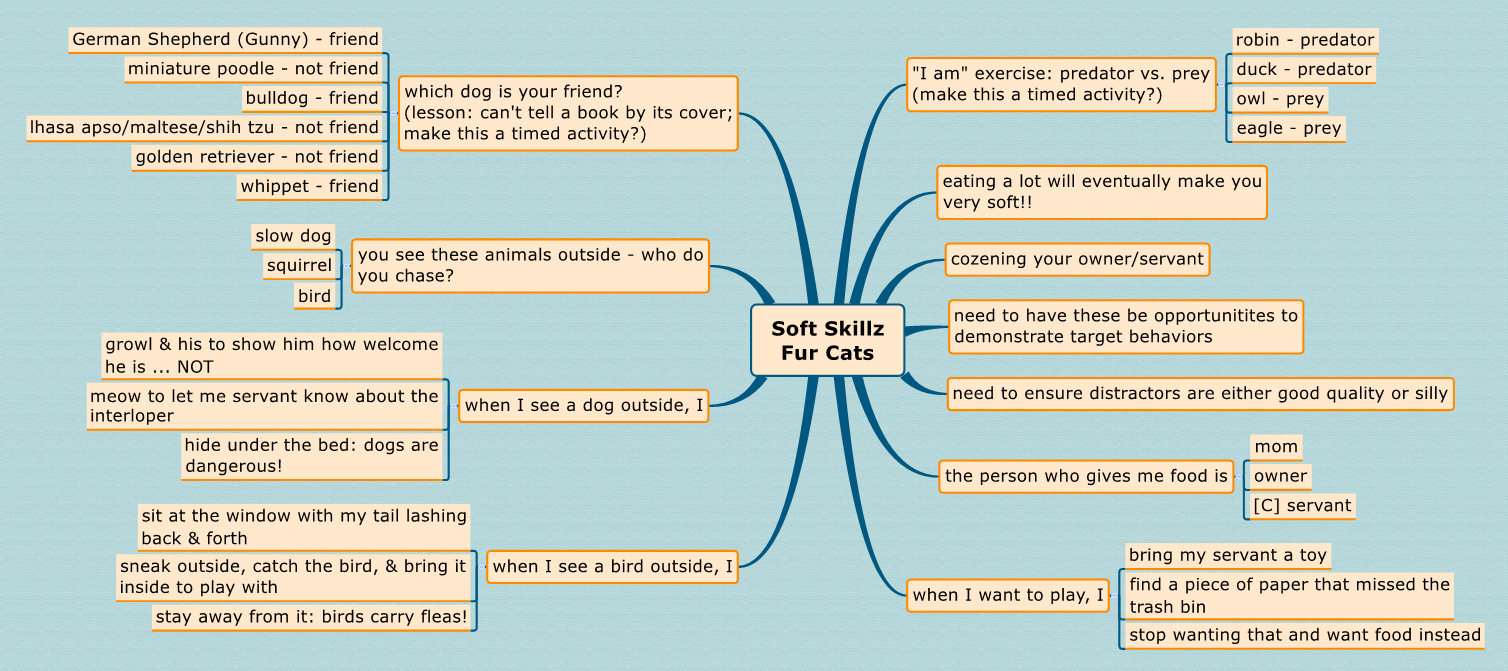
Here’s the initial mindmap / brain dump for the course:
instructional designer, grapheme synesthete, beadweaver, whatever
Here’s the initial mindmap / brain dump for the course:
Since I can’t share any “real” work projects, which are all proprietary for my company’s clients, I figured I might as well make this fun.
Here are the silly topic I’ve chosen for #id6wc and some even sillier formal learning objectives that Mr. Bloom would approve of.
After completing this course, teh kittehs will be able to:
Next step, a mind map.
I’m so excited to be participating in my friend Cara North’s “Instructional Design 6 Week Challenge”!
Since I’m mostly a writer in the L&D field and haven’t worked in any of the authoring tools for nearly 10 years, I’m starting from Ground Zero as far as e-learning development.
My plan is to define, outline, and storyboard a course whilst learning the basics of Articulate Storyline via their (generous!) 60-day free trial and the Storyline workbooks from IconLogic. Then during weeks 5-6 of the challenge, I’ll hopefully be ready to develop at least a bit of my course and post it online.
All of this will help prepare me for Learning DevCamp in mid-June – so excited to attend & participate in that event!
The rest of the posts in this series will follow my progress through ID6WC.
And awaaaay we go!
So many learning and development initiatives today involve the use of online interaction via video chat.
There are more and more apps and online tools for this all the time, and I agree that discussion and debate can be a good thing, allowing us to learn informally from peers.
Yet …
“Hanging out in a chat” can also be a lot like high school socializing.
And if we never want or need to do any more for the world than we did while hanging out next to our lockers in high school, that’s perfectly fine.
But if we want to pursue goals with more of an impact on humanity than that, we can’t spend most of our time kibbutzing.
We need –
Training time spent on social learning isn’t wasted, but its value is diminished if it’s not guided by an overarching purpose.
Self-discipline is a good thing.
Training industry thought leader Cathy Moore is a strong proponent – indeed a pioneer – of an instructional format that places the content to be learned into reference materials so that people do not need to memorize (remember) information – they just refer to their job aids.
In a recent webinar, cognitive neuroscientist Dr. Carmen Simon stated that “People can’t act on what they can’t remember” (what they haven’t memorized). Her research and consultancy focus on the goal of making information more memorable.
These two positions, taken in their purest forms, cannot both be right.
Each training project needs to balance appropriate memory stimulation for knowledge transfer against flexible just-in-time performance support tools that prevent cognitive overload (with the realization that “overload” varies among individuals).
But stepping back for a larger perspective, why is it OK for us to want people to remember (memorize) a marketing message, but not OK to want them to memorize (remember) processes and requirements for performing their duties as an employee?
Usability guru Steve Krug’s groundbreaking book Don’t Make Me Think was about designing products and websites that are intuitively easy to use. It was not, I suspect, intended to be a philosophy of life.
Here’s an idea:
Instead of gamifying training, why don’t organizations gamify their employees’ career paths?
For example, a person who completes a project “quest” could “level up” to better office equipment or a better location for their desk or a chance to be on a cross-functional team or etc. Offer visible/tangible rewards – rewards that come more frequently than promotions to a new position and that are available to everyone who levels up, not just a select few and the rest get weeded out.
I wonder if anyone has tried this before and, if so, if it worked?