This week was a busy one with multiple deliverables due, so not much Storyline progress.
But I do have something to share – a PowerPoint animation. 🙂
My narration in the video explains the wheretofore.
instructional designer, grapheme synesthete, beadweaver, whatever
This week was a busy one with multiple deliverables due, so not much Storyline progress.
But I do have something to share – a PowerPoint animation. 🙂
My narration in the video explains the wheretofore.
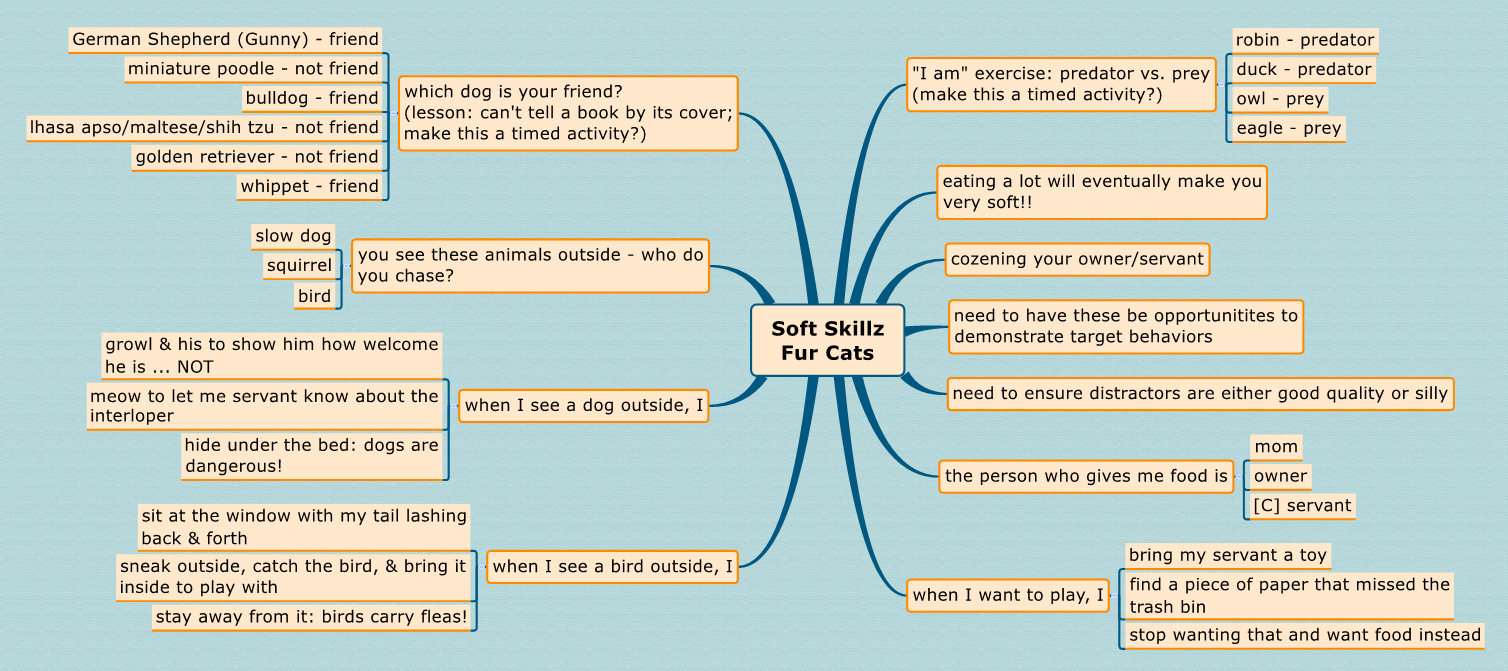
Here’s the initial mindmap / brain dump for the course:
At last!
I’ve finally uploaded my more recent beadweaving pieces to my gallery.
As soon as I get a chance, I’ll add descriptive text, but for now at least the images are available. The image file name has the year of creation and a couple words – that’s a start.
Most of the pieces are my own custom designs; some are from classes I’ve taken or patterns from magazines or online artists. That information will be in the descriptions ASAP.
I’ve felt that I haven’t done much, but … There are 29 IMAGES! Some contain more than one piece, and some have insets of details.
Enjoy!
Think again.
For years now, “multitasking” has been a buzzword in personal and professional circles. An online search on the term quickly returns tens of millions of hits, and most of the recent results have titles that question whether anyone can really multitask at all. This brief post shares some big ideas and links to where you can start learning more.
Study after study from researchers around the globe indicates that the human brain is wired to focus on one thing – and only one thing – at a time. When people think they are multitasking, they are actually doing one of two things:
But surprise! It turns out that 2 percent of us actually can multitask! These people are called “supertaskers,” and a free online test will let you know if you are part of the 2 percent. (No, I’m not – just reading the description of the test was enough for me!)
While supertasking appears to be an inborn ability, some studies propose that anyone can “learn” to do more than one thing at once.
However, what those studies actually show is that a person can learn a task thoroughly enough that it becomes a background task for them, at which point it’s not multitasking any more. And “consuming multiple streams of information at the same time” is also not multitasking: it’s just passive background tasking.
So the current answer to this question is No, multitasking can’t be learned.
Most of us switchtask all the time – we have to, in order to live our lives.
But after a certain point, switchtasking begins to take a toll on our productivity, on the quality of our work, and on our stress levels. Don’t believe it? Take this classic test to prove it to yourself; it’ll be 5 minutes well spent.
Recently, neuroscientists using functional MRI (fMRI) scans of the brain have found that habitual switchtasking over a period of several years can result in an “addiction to distraction” and cause certain parts of the brain to atrophy. This alarming news is offset, though, by proof that “neuroplasticity” (the brain’s ability to heal itself and grow new connections) keeps going as long as we live. The idea that our brains die off as we age is just a fable (hooray!).
Our brains might not die off, but it’s common knowledge that they do slow down. In fact, maximum brain speed is attained around the age of 25, and after that the slow-down begins.
So, as you’d expect, younger people are typically better at switchtasking since they can turn their attention more quickly.
But it turns out that older people bring something else to the table. fMRI scans of older brains show activity in a greater number of areas when performing the same task – indeed, activity sometimes even crosses between the two sides of the mature brain in ways not seen in the young, indicating an increase in lateral, creative thinking. When I compare my problem-solving process now with how I approached things years ago, it seems to match these findings: my experience adds an intuitive dimension I never had before.
What I conclude from this information is that an ideal project team will include both younger and older members: speedy minds that can accomplish tasks quickly and experienced minds that can leverage subtle insights. Inter-generational collaboration for the win!
One of the most difficult parts of writing this post was cutting off my research. There are vast quantities of data out there, and more every day. The links below will take you to solid information that’s written in layman’s terms, not science jargon. I encourage you to begin your own exploration!
Note: This post was originally written for my employer, Cinécraft Productions Inc.
I’m a big fan of the “Jon & Lobo” series by sci-fi author Mark Van Name.
Though I’d love to see new volumes more often, I admire what Mark does in his day job: being a principle of a successful tech company that provides good jobs to a bunch of folks.
Recently, he’s been involved in another initiative that IMO is quite worthwhile. It’s called Limit Your Greed, and the name really says it all. I encourage you to check out their website for the full message.
Now I just need to figure out which shirt to buy!